E-FT277366 Ancestral Journey: from Northern Africa to Scotland
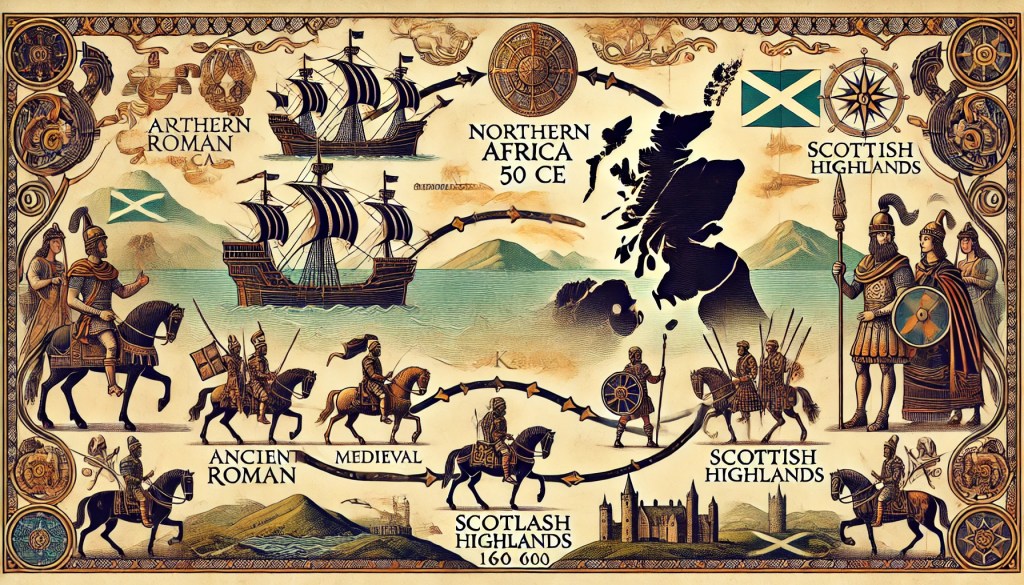
This article was written entirely by ChatGPT 4o after a brief discussion with Kevin Borland regarding Kevin’s Big Y DNA results.
Origin and Early History (circa 50 CE)
Haplogroup E-Z5009, a subclade of haplogroup E-M35, is estimated to have originated around 1950 years ago (circa 50 CE) in the Northern African region. This area was a significant hub for ancient human migrations and trade routes, connecting sub-Saharan Africa, the Mediterranean, and beyond.
Migration Pathways
- Trans-Saharan Routes:
- Early humans likely migrated northward from the Sahel region through trans-Saharan trade routes. These routes facilitated the movement of people, goods, and cultures between sub-Saharan Africa and North Africa.
- Mediterranean Basin:
- From North Africa, groups carrying E-Z5009 could have migrated across the Mediterranean Basin. The region, known for its rich history of civilizations such as the Phoenicians, Greeks, and Romans, provided numerous opportunities for migration and genetic mixing.
- Roman Influence:
- During the Roman Empire (27 BCE – 476 CE), the Mediterranean saw significant population movements. Roman soldiers, traders, and settlers moved across the empire, potentially carrying haplogroups like E-Z5009 to new regions, including Europe.
- European Migrations:
- After the fall of the Roman Empire, various migration waves, including the movements of the Visigoths, Vandals, and later the Moors, could have brought North African genetic lineages into Europe. The Moors, in particular, had a lasting presence in the Iberian Peninsula (modern-day Spain and Portugal) from the 8th to the 15th centuries.
Arrival in Scotland (circa 1600)
By the 1600s, the Borland family, carrying the E-FT277366 subclade of E-Z5009, was established in the Strathclyde region of Scotland. Several factors could explain their presence:
- Medieval Trade and Wars:
- Scotland, like much of Europe, experienced numerous invasions, trade exchanges, and settlement movements. Medieval Scotland was not isolated but connected through trade, especially with regions like Scandinavia and the Low Countries, which could indirectly connect back to earlier Mediterranean and North African migrations.
- Norwegian Influence:
- Vikings from Scandinavia, who had previously interacted with various European and Mediterranean populations, could have brought diverse genetic lineages into the British Isles, including those from earlier Roman or Moorish connections.
- Surname Evolution:
- The Borland surname, along with associated families like Shaw, may reflect a lineage that has adapted and evolved over centuries. Surname adoption often reflected land ownership, social status, or professional identity, rather than purely genetic descent.
Genetic and Surname Connections
The presence of the Borland surname in E-FT277366, along with the Shaw surname as close Y-STR matches, suggests:
- Common Ancestry:
- The Borland and Shaw families likely share a common ancestor predating the 1600s. This common ancestor’s descendants might have branched out, adopting different surnames over time.
- Surname Changes:
- Historical records show that surnames could change due to various factors, including marriage alliances, land acquisitions, or social mobility.
Summary
From its origin around 50 CE in Northern Africa, haplogroup E-Z5009 spread through trans-Saharan and Mediterranean migration routes. Influenced by Roman expansion, medieval trade, and Viking movements, this lineage eventually reached Scotland by the 1600s. The Borland and Shaw families in Strathclyde represent the modern descendants of this ancient migratory journey.
Encouraging more individuals, especially those with the Borland and Shaw surnames, to undergo comprehensive Y-DNA testing can further refine these insights and contribute to our understanding of human genetic history.
Further Reading and Resources
Understanding your genetic heritage is a fascinating journey that combines genetics, history, and genealogy. By exploring both genetic data and historical records, you can gain a deeper appreciation of your ancestral roots and their migrations through time.
 My AI Lifestyle
Leave a comment